Showing posts with label square-mesh. Show all posts

Tuesday, July 7, 2020

Square-mesh netting - a variety of shapes


Every so often I realize that it's becoming difficult to find instructions to specific netting patterns. This week I realized that this was the case with the different shapes of square-mesh netting. So I've made a list of the shapes and included a link to where information, instructions, and images can be found. 

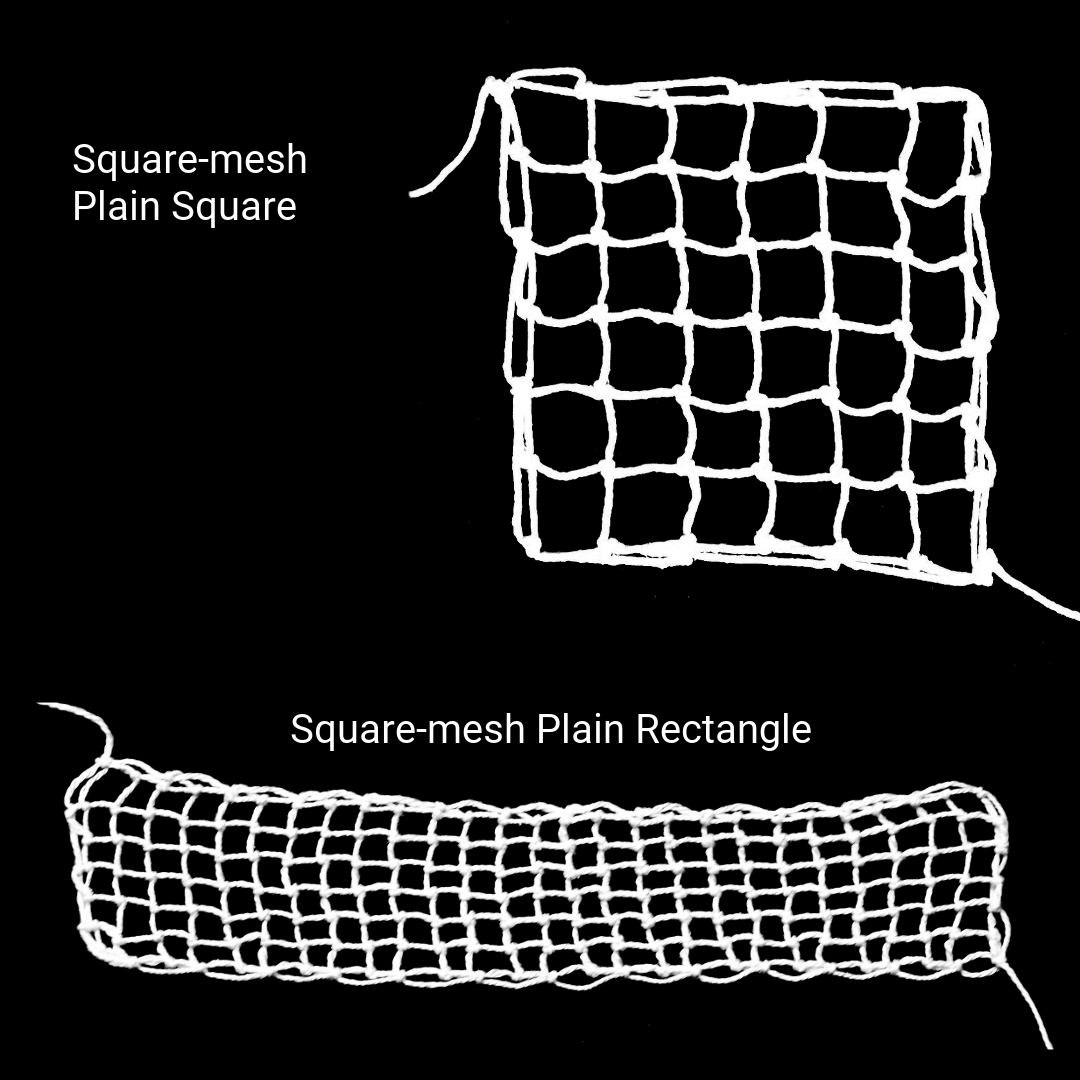
Square-mesh netting is often thought of as a square or rectangle. As such, it can be made with:


In addition to squares and rectangles, square-mesh netting can also form a


Square-mesh netting can also create:

Thursday, July 2, 2020

One Pointed End on a Rectangle of Square-mesh Netting


Last summer I was working on square-mesh triangles. As I was checking the triangle patterns, I realized that I had never combined a rectangle with a triangle. 

I discovered that if the width of the rectangle is odd, the triangle will have a single point. (If the width is of the rectangle is even, there will be two squares at the point, but that's a post for another day.)

By the time I finished the netting, I ran out of time to post them, so here they are, a year late. 


Instructions for: 

Rectangle of Square-mesh Netting – From One Corner with One Pointed End

Odd width 9 squares, Even length 18 squares, 5 points along pointed sides


Form the Rectangle Width
Row 1:  Net 2 knots in the foundation loop. (2 loops in the row)
Remove the mesh stick and turn the work so that the next row can be worked from left to right. (This will be done at the end of each row.)
Row 2:  Net 1 knot in the first loop on the left; increase by netting 2 knots in the second loop. (3 loops in the row)
Row 3:  Net 1 knot in each loop except the last loop; net 2 knots in that last loop. (4 loops in the row)
Row 4:  Net 1 knot in each loop except the last loop; net 2 knots in that last loop. (5 loops in the row)
Row 5:  Net 1 knot in each loop except the last loop; net 2 knots in that last loop. (6 loops in the row)
Row 6:  Net 1 knot in each loop except the last loop; net 2 knots in that last loop. (7 loops in the row)
Row 7:  Net 1 knot in each loop except the last loop; net 2 knots in that last loop. (8 loops in the row)
Row 8:  Net 1 knot in each loop except the last loop; net 2 knots in that last loop. (9 loops in the row)
Row 9: Net 1 knot in each loop except the last loop; net 2 knots in that last loop. (10 loops in the row) 
Row 10:  Net 1 knot in each loop except the last loop; net 2 knots in that last loop. (11 loops in the row)
Lengthen the Rectangle
Row 11: (Decrease Row Net 1 knot in each loop until you come to the last 2 loops; net the last 2 loops together. (10 loops in the row)

Row 12: (Increase row): Net 1 knot in each loop except the last loop; net 2 knots in the last loop. (11 loops in the row)
  Row 13: (Decrease Row Net 1 knot in each loop until you come to the last 2 loops; net the last 2 loops together. (10 loops in the row)

Row 14: (Increase row): Net 1 knot in each loop except the last loop; net 2 knots in the last loop. (11 loops in the row)
Row 15: (Decrease Row Net 1 knot in each loop until you come to the last 2 loops; net the last 2 loops together. (10 loops in the row)

Row 16: (Increase row): Net 1 knot in each loop except the last loop; net 2 knots in the last loop. (11 loops in the row)
Row 17 (Decrease Row): Net 1 knot in each loop until you come to the last 2 loops; net the last 2 loops together. (10 loops in the row)

Row 18: (Increase row): Net 1 knot in each loop except the last loop; net 2 knots in the last loop. (11 loops in the row)
Row 19: (Decrease Row): Net 1 knot in each loop until you come to the last 2 loops; net the last 2 loops together. (10 loops in the row)


Finish the Rectangle with a Lacy Point
Row 20: (Plain row): Net 1 knot in each loop. (9 loops in the row)

Row 21: (Decrease Row): Net 1 knot in each loop until you come to the last 2 loops; net the last 2 loops together. (8 loops in the row)

Row 22: (Plain row): Net 1 knot in each loop. 8 loops in the row)

Row 23: (Decrease Row): Net 1 knot in each loop until you come to the last 2 loops; net the last 2 loops together. (7 loops in the row)

Row 24: (Plain row): Net 1 knot in each loop. (7 loops in the row)

Row 25: (Decrease Row): Net 1 knot in each loop until you come to the last 2 loops; net the last 2 loops together. (6 loops in the row)

Row 26: (Plain row): Net 1 knot in each loop. (6 loops in the row)

Row 27: (Decrease Row): Net 1 knot in each loop until you come to the last 2 loops; net the last 2 loops together. (5 loops in the row)


Saturday, June 15, 2019

Square-mesh Triangle - 13 squares across the top


Recently Pinterest sent me a picture of a square-mesh shawl and I realized that even through I had squares and rectangles in square-mesh netting, I did not have a pattern for a triangle. So I decided to make one. I chose to have an odd number of squares across the top of the triangle. There are 3 squares in the border, 13 squares across the top, 7 points along the sides, and one square forming the point at the bottom.


Square Mesh Triangle Instructions

Tie the thread from the netting needle onto the foundation loop, leaving a 6" tail. Turn the netting at the end of each row.

Row 1: Net 2 more knots in the foundation loop. (2 loops in the row)
Row 2: Net 1 knot in each loop except the last loop; net 2 knots in the last loop. (3 loops in the row)
Row 3: Net 1 knot in each loop. (3 loops in the row)
Row 4: Net 1 knot in each loop except the last loop; net 2 knots in the last loop. (4 loops in the row)
Row 5: Net 1 knot in each loop. (4 loops in the row)
Row 6: Net 1 knot in each loop except the last loop; net 2 knots in the last loop. (5 loops in the row)
Row 7: Net 1 knot in each loop. (5 loops in the row)
Row 8: Net 1 knot in each loop except the last loop; net 2 knots in the last loop. (6 loops in the row)
Row 9: Net 1 knot in each loop. (6 loops in the row)
Row 10: Net 1 knot in each loop except the last loop; net 2 knots in the last loop. (7 loops in the row)
Row 11: Net 1 knot in each loop. (7 loops in the row)
Row 12: Net 1 knot in each loop except the last loop; net 2 knots in the last loop. (8 loops in the row)
Row 13: Net 1 knot in each loop. (8 loops in the row)
Row 14: Net 1 knot in each loop. (8 loops in the row)
Row 15: Net 1 knot in each loop until 2 loops are left, net those 2 loops together. (7 loops in the row)


Forming the first square of the netting
1. Remove the foundation loop from row 1 of the netting.
2. Tie the tail onto a tapestry needle, which is used in place of the netting needle.
3. Place the foundation-loop cord through another row of meshes.
4. Tie the foundation-loop cord into a circle and attach it to a tension device.
5. Net the first two loops together without using a mesh stick.


Saturday, August 25, 2018

A Rectangular Square-Mesh Frame an Odd Number of Squares in the Width and with an Even Number of Squares in the Length


Over the past few weeks I have tried various combinations of odd and even numbers of squares to create a net frame. This week there is only one variation left to try (odd width and even length), so I decided to make a net frame with the following numbers:
  • the outer width 11 squares and the inner width 5 squares
  • the outer length 16 squares and the inner length 10 squares
  • the border 3 squares 


Before starting the actual netting:
1.       Fill a netting needle or shuttle with thread or cord.
2.       Attach it to a foundation loop.  To do this:
a.      Tie a slip knot in the thread or cord coming from the needle or shuttle.  Leave a long tail, at least 6 to 8 inches.
b.      Slip the foundation-loop cord through the slipknot.
c.      Tie the foundation-loop cord into a circle thereby creating a foundation loop.
d.       Tighten the slipknot.                        
3.       Attach the foundation loop to a tension device.
4.       Choose a mesh stick.

Increase Portion of the Square
Row 1
Net 2 more knots into the foundation loop.  (2 loops in the row)

Remove the mesh stick and turn the work so that the next row can be worked from left to right. (This will be done at the end of each row.)
Row 2
Net 1 knot in the first loop; increase by netting two knots in the 2nd loop. (3 loops in the row)
Row 3
 Net 1 knot in each loop for 2 loops, net 2 knots in the last loop. (4 loops in the row)
Rows 4-7
 Continue repeating row 3. (8 loops in final row)

Forming the top of the square
Row 8
(first partial row) Divide the number of loops in half and net 1 knot in each loop for half of the loops.  (4 loops in the row)
Row 9
 Net 1 knot in each loop, except the last loop, net 2 knots in the last loop. The increase is on the outer edge. (5 loops in the row)
Row 10
 Net 1 knot in each loop, except the last 2 loops, net the last 2 loops together. The decrease is on the inner edge. (4 loops in the row)
Row 11
 Net 1 knot in each loop, except the last loop, net 2 knots in the last loop. The increase is on the outer edge. (5 loops in the row)

Turn Corner and Start Side
Row 12
 Net 1 knot in each loop except the last 2 loops, net the last 2 loops together, net 1 more knot in those two loops. (5 loops in the row)
Row 13
 Net 1 knot in each loop, except the last 2 loops, net the last 2 loops together. The decrease is now on the outer edge. (4 loops in the row)
Row 14
 Net 1 knot in each loop, except the last loop, net 2 knots in the last loop. The increase is now on the inner edge. (5 loops in the row)
Row 15
 Net 1 knot in each loop, except the last 2 loops, net the last 2 loops together. The decrease is now on the outer edge. (4 loops in the row)
Row 16
 Net 1 knot in each loop, except the last loop, net 2 knots in the last loop. The increase is now on the inner edge. (5 loops in the row)
Row 17
 Net 1 knot in each loop, except the last 2 loops, net the last 2 loops together. The decrease is now on the outer edge. (4 loops in the row)
Row 18
 Net 1 knot in each loop, except the last loop, net 2 knots in the last loop. The increase is now on the inner edge. (5 loops in the row)
Row 19
 Net 1 knot in each loop, except the last 2 loops, net the last 2 loops together. The decrease is now on the outer edge. (4 loops in the row)
Row 20
 Net 1 knot in each loop, except the last loop, net 2 knots in the last loop. The increase is now on the inner edge. (5 loops in the row)
Row 21
 Net 1 knot in each loop, except the last 2 loops, net the last 2 loops together, net 1 more knot in these 2 loops. (5 loops in the row)

Cut the thread on the outer edge.

Start the Second Half of the Square
Tie the thread from the needle onto the bottom of the first loop of the last complete increase row.
1.       Tie the end of the thread from the shuttle to the appropriate loop.
2.       Without using a mesh stick, tie a netting knot into the same loop.
3.       Untie the original knot that joined the shuttle to the loop, leaving just the netting knot.

Row 8
 (second part of the first partial row) Net 1 more knot in the loop in which the needle is tied, net 1 knot in each loop for the remaining loops on this partial row. (4 loops in the row)
Row 9
 Net 1 knot in each loop, except the last loop, increase by netting 2 knots in the last loop. The increase is on the outer edge. (5 loops in the row)
Row 10
 Net 1 knot in each loop for 2 loops, net the last 2 loops together. The decrease is now on the inner edge. (4 loops in the row)
Row 11
 Net 1 knot in each loop, except the last loop, increase by netting 2 knots in the last loop. The increase is on the outer edge. (5 loops in the row)
Row 12
 Net 1 knot in each loop for 2 loops, net the last 2 loops together. The decrease is now on the inner edge. (4 loops in the row)
Row 13
 Net 1 knot in each loop, except the last loop, increase by netting 2 knots in the last loop. The increase is on the outer edge. (5 loops in the row)
Row 14
 Net 1 knot in each loop for 2 loops, net the last 2 loops together. The decrease is now on the inner edge. (4 loops in the row)
Row 15
 Net 1 knot in each loop, except the last loop, increase by netting 2 knots in the last loop. The increase is on the outer edge. (5 loops in the row)
Row 16
 Net 1 knot in each loop for 2 loops, net the last 2 loops together. The decrease is now on the inner edge. (4 loops in the row)
Row 17
 Without a mesh stick, net 1 knot in the first loop, now using the mesh stick, net 1 more knot in that first loop, net 1 knot in each of the remaining loops. (5 loops in the row)

Turn Corner and Start Bottom Side
Row 18
 Net 1 knot in each loop except the last loop, net 2 loops in the last loop. (5 loops in the row)
Row 19
 Net 1 knot in each loop, except for the last 2 loops, net the last 2 loops together. The decrease is now on the outer edge. (4 loops in the row)
Row 20
 Net 1 knot in each loop, except the last loop, increase by netting 2 knots in the last loop. The increase is now on the inner edge. (5 loops in the row)
Row 21
 Net 1 knot in each loop, except for the last 2 loops, net the last 2 loops together. The decrease is now on the outer edge. (4 loops in the row)


Join Partial Rows and Decrease
Row 22
 Net 1 knot in each loop for 3 loops, net the next two loops together, (joining both partial rows), net 1 knot in each loop except the last 2 loops, net the last 2 loops together (7 loops in the row)
Row 23
 Net 1 knot in each loop except for the last 2 loops, net the last 2 loops together.

Repeat Row 23 until there are two loops left. 
               

Tie the Last Corner        

Finish the final row by netting these two loops together, but without a mesh stick.
Cut the thread near the knot just tied.

Tie the First Corner

Remove the foundation loop from row one of the net.
Tie the tail onto a tapestry needle, which is used in place of the netting needle.
Net the first two loops together without using a mesh stick.
Cut the thread near the knot just tied.

Saturday, August 18, 2018

A Rectangular Square-Mesh Frame with an Even Number of Squares in the Width and an Odd Number of Squares in the Length


Having made the rectangular square-mesh frame with an odd number in both the width and length,  as well as with an even number in both the width and length, I wondered what would be different if I mixed odd and even numbers in both the width and the length. I decided to make a frame with the following numbers:
  • the outer width 12 squares and the inner width 4 squares
  • the outer length 15 squares and the inner length 7 squares
  • the border 4 squares 


Instructions


Before starting the actual netting:
1.       Fill a netting needle or shuttle with thread or cord.
2.       Attach it to a foundation loop.  To do this:
a.   Tie a slip knot in the thread or cord coming from the needle or shuttle.  Leave a long tail, at least 6 to 8 inches.
b.   Slip the foundation-loop cord through the slipknot.
c.     Tie the foundation-loop cord into a circle thereby creating a foundation loop.
d.    Tighten the slipknot.                    
3.       Attach the foundation loop to a tension device.
4.       Choose a mesh stick.

Increase Portion of the Rectangle
Row 1
Net 2 more knots into the foundation loop.  (2 loops in the row)
Remove the mesh stick and turn the work so that the next row can be worked from left to right. (This will be done at the end of each row.)
Row 2
Net 1 knot in the first loop; increase by netting two knots in the 2nd loop. (3 loops in the row)
Row 3
Net 1 knot in each loop except the last loop, net 2 knots in the last loop. (4 loops in the row)
Rows 4-9
Continue repeating row 3. (10 loops in final row)


Forming the top of the rectangle
Row 10
(first partial row) Divide the number of loops in half and net 1 knot in each loop for half of the loops.  (4 loops in the row)
Row 11
Net 1 knot in each loop, except the last loop, net 2 knots in the last loop. The increase is on the outer edge. (5 loops in the row)
Row 12
Net 1 knot in each loop, except the last 2 loops, net the last 2 loops together. The decrease is on the inner edge. (4 loops in the row)
 

Turn Corner and Start Side
Row 13
Without a mesh stick, net 1 knot in the first loop, now using the mesh stick, net 1 more knot in that loop, net 1 knot in each remaining loop. (5 loops in the row)
Row 14
Net 1 knot in each loop, except the last loop, net 2 knots in the last loop. The increase is now on the inner edge. (6 loops in the row)
Row 15
Net 1 knot in each loop, except the last 2 loops, net the last 2 loops together. The decrease is now on the outer edge. (5 loops in the row)
Rows 16-19
Repeat rows 14-15. The last row will be a decrease row.

Cut the thread on the outer edge.


Start the Second Half of the Rectangle
Tie the thread from the needle to the bottom of the first loop of the last complete increase row.
1.       Tie the end of the thread from the shuttle to the appropriate loop.
2.       Without using a mesh stick, tie a netting knot into the same loop.
3.       Untie the original knot that joined the shuttle to the loop, leaving just the netting knot.

Row 10
 (second part of the first partial row)
Net 1 more knot in the loop in which the needle is tied, net 1 knot in each loop for the remaining loops on this partial row. (5 loops in the row)
Row 11
 Net 1 knot in each loop, except the last loop, increase by netting 2 knots in the last loop. The increase is on the outer edge. (6 loops in the row)
Row 12
 Net 1 knot in each loop for 2 loops, net the last 2 loops together. The decrease is now on the inner edge. (5 loops in the row)
Rows 13-15
Repeat rows 11 and 12. The last row will be an increase row.

Turn Corner and Start Bottom Side
Row 16
Net 1 knot in each loop except the last 2 loops, net the last 2 loops together, net 1 more knot in those two loops.  (6 loops in the row)
Row 17
Net 1 knot in each loop, except for the last 2 loops, net the last 2 loops together. The decrease is now on the outer edge. (5 loops in the row)
Row 18
Net 1 knot in each loop except the last loop, net 2 loops in the last loop. The increase is now on the inner edge. (6 loops in the row)
Row 19
Net 1 knot in each loop, except for the last 2 loops, net the last 2 loops together. The decrease is now on the outer edge. (5 loops in the row)

Cut the thread on the inner edge.

Join Partial Rows and Decrease
Row 20
Net 1 knot in each loop for the same number of loops as squares in the Border (B), net the next two loops together (joining both partial rows), net 1 knot in each loop except the last 2 loops, net the last 2 loops together.   (9 loops in the row)
Row 21
 Net 1 knot in each loop except for the last 2 loops, net the last 2 loops together. (8 loops in the row)
Rows 22-27
Repeat Row 21 until there are two loops left. 
           
Tie the Last Corner              
Finish the final row by netting these two loops together, but without a mesh stick.
Cut the thread near the knot just tied.

Tie the First Corner
Remove the foundation loop from row one of the net.
Tie the tail onto a tapestry needle, which is used in place of the netting needle.
Net the first two loops together without using a mesh stick.
Cut the thread near the knot just tied.