Saturday, July 21, 2012

Gauge = mesh stick size and yarn size


I was looking at the patterns for my upcoming Circular Netting class.  I noticed that I had only one hot pad.  It uses the plain stitch.   
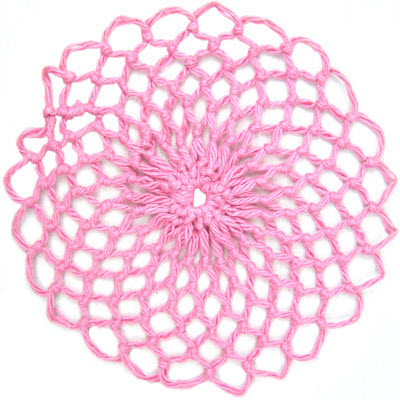

As I continued to transform the instructions for the net coasters from something I could understand to a handout everyone could understand, I realized I could have more hot pad patterns.  I just needed to make some changes to the coaster patterns.  

By using thicker thread and larger mesh sticks I went from coaster to hot pad.  The inserts in the acrylic coasters are just under 3 inches.  The hot pads are between 5 and 6 inches.


In knitting and crocheting how tightly you grip your yarn and needle affects the gauge and the finished size of your project.  This is not what happens with netting.  The finished size of an article of netting depends on the size of the yarn or thread and the size of the mesh sticks used.


Saturday, July 14, 2012

Net Handles for Bags


I first came across the idea for netting bags in Charles Holdgate's book Net Making.  For handles he suggested making several long strands and then tying a series of half-hitches in the center of those strands.  It worked, but not well.  I would arrive home after carrying groceries in the bags, with welts on my arms or cramped hands where the handle had rested.

No matter what I tried, thick cord, rope, or padded cloth, the handles dug into my skin.  I kept looking for an idea that would work.  Eventually someone graciously informed me that I could net the handle.  What an eye-opening concept!  Since then, most of my net bags have net handles.  The netting seems to spread the weight of the bag over a larger surface area and my hands, and arms no longer have problems carrying net bags.

This week, as I photographed the bags for my circular netting class,  I realized that I had taken a bag pattern and changed the look by changing just the handle.

One example is the medium-size circular bag.


The bag in each photo is the same size; the handle on the left is a draw-string, and on the right is a tied net handle.


I had a similar situation with the large size circular net bag.


The bag on the left holding five pounds of potatoes has a single net handle.


The bag on the right, holding a mixture of fresh vegetables, uses the same pattern for the bag and the start of the handle as the one on the left.  The center of this bag's handle is tied together rather than net together.

I like the tied handles for grocery shopping because I can tie the handles so the contents of the bag won't come out.


Saturday, July 7, 2012

Spiral Netting vs Circular Netting


While diamond-mesh and square-mesh netting are made with rows, spiral and circular netting are made using rounds

My grandmother taught me to net using spiral netting.  Spiral netting goes around and around until you change the size of the mesh stick or stitch pattern, or finish the project.  


Here is a doily she made for me to use as a pattern.  It is done in spiral netting and is a good example of some of the problems associated with spiral netting.


Here are some closeups of that doily highlighting three common problems experienced with spiral netting.  


The end of the netting is very obvious.  It just stops.


In the highlighted area there is a noticeable trail in the netting where the size of the mesh stick was changed.  It may appear as a jog in the round or a single long strand where there should be two or more strands forming a V. 


Counting the number of rounds becomes a challenge because the round has no definite beginning or end.

If you look closely in the highlighted area you can see that there are mostly 5 rounds of small white netting.  However, there are a couple of places where there are only 4 rounds.  This makes it difficult to know when to change to a new mesh stick or a new stitch.


It was years after I had learned to net that I found there was another way to net in a circle.   Thanks to a small public library I found Net Making by Charles Holdgate and learned about circular netting.


Here is the same doily made using circular netting.  


Circular netting joins each round with an overhand knot.  

This simple step eliminates the problems described with spiral netting.


This week I found myself adding more projects to the Circular Netting class I am creating.  There are now seven different types of projects in this class and 15 patterns:  3 bags, 3 bookmarks, 3 coasters, 3 dishcloths, a doily, a hot pad, and a snood.

If you could choose only one type of project to make while learning circular netting, which would it be?

You can look at the projects at Rita's Netting Nook.


Saturday, June 30, 2012

Small Circular Netting: A coaster, potholder, or hot pad?


One of the challenges in creating a new netting class is creating quick, easy, and useful projects.  The circular netting class I'm working on is no exception.

When I learned to net, my grandmother started me with spiral netting.  (I didn't realize that there was any other type of netting for years.)  Since she started the center on my first two doilies, I didn't even get to try the process for over a year.  And since each doily took a long time to complete I had a hard time remembering how to start the doily.

I wanted to avoid that problem with my students, so I have created several small circular projects.  Here are the latest.


7" diameter
5" diameter


I was not sure what to call them.  Are they coasters, potholders, or hot pads?


A friend recently experimented with these net yarn items. She found that they worked great when holding hot items like a cup of tea or coffee.  The steam and heat did not transfer to the surface below.  She also found they did not work so great with cold soft drink cans.  The condensed moisture that gathered on the surface of the can dripped through the holes onto the surface below. 

I guess that means I should stop calling them coasters and start calling them hot pads.  What would you call them?


Saturday, June 23, 2012

Net Hats Using Diagonal Netting


Even before I had finished netting my first hat, I found myself planning the second one.  I wanted to do the entire hat in the Diagonal Netting Stitch but had difficulties figuring out how to do the first two stitches of the round.    So, I decided to net two plain stitches and then one Diagonal Netting Stitch.  I followed that sequence for the rest of the hat.


As you can see on a back view of the hat, the nine Diagonal Netting Stitches gently curve around the hat.


I still wanted to try just the Diagonal Netting Stitch.  After leaving the problem of starting the round with the Diagonal Netting Stitch at the back of my mind for a few days, I received the answer to solve the problem.  Here is the small hat that resulted.

I said small hat because even though I had the same number of  loops in this hat as I did in the one above, the red one would fit an adult and the blue one would fit a new-born.  There are two reasons this happened. First, I changed  from a 1/2" to a 3/8" mesh stick.  Second, I removed the plain stitches from the pattern and made all the stitches the Diagonal Netting Stitch.  This stitch pulls the netting closer together and results in a smaller piece of netting for the same number of stitches.  Either change by itself would have resulted in a smaller hat.  Doing both in the same hat resulted in a very small hat.

Since I want to see how this hat pattern looks in an adult size, I'll be working with either many more loops per round, or a bigger size mesh stick, both slightly more loops and a larger mesh stick as I try the pattern again this week.


Saturday, June 16, 2012

Net Hat


When I saw the hat several women I know were crocheting, the look reminded me of  netting.   I couldn't help myself.  I had to pull out my trusty, ever-present tape measure and measure the crocheted mesh.

I had never thought of netting a hat until I saw this one, and then I could not stop thinking about it.  Finally I gave in. I wrote down a basic pattern and produced my first net hat.  I even net a small flower to attach to the side with a small bead.

I think I need to use a thicker thread for this hat pattern.  What do you think?


A net hat is different from a snood.  The hat sits on the head, covering only part of the hair.

A net snood can also sit on the head . . .


or attach to a barrette.


Either way,  the snood encloses the hair and pulls the hair together.

Of course, one hat was not enough.  I no sooner finished the first hat when another pattern began to occupy my mind.  I kept thinking of the Diagonal Netting Stitch, even when I had problems converting that stitch from diamond mesh netting to circular netting.  And even before the second one was finished, a third pattern (a variation on the second hat pattern) began presenting itself for consideration.   If I have enough time this week, I might finish one or both of the additional net hat patterns.


Saturday, June 9, 2012

Net Produce Bags


Recently I was asked if I could net a small bag to hold garlic bulbs and a larger bag to hold 5 pounds of potatoes.  Here are the results of my efforts.  Both of the bags are made of household string.

Three garlic bulbs are in the bag.  

Five pounds of potatoes are in this bag.

This week I was also able to give Knots Indeed a new look.  I tried to make sure everything got moved.  If I forgot something, please let me know.  It's not finished by any means -- I still have add more photos, links to patterns, and eventually a shopping cart.

I was also able to get the projects and syllabus listing up for the Circular Netting class.