Saturday, August 18, 2012

Why I make netting class patterns several times


In May, 2012, I displayed photos of the net dishcloths I've designed for my circular netting class.  Recently I remade the same dishcloths using colored yarn.  I've learned that by making them a second and maybe a third time, I will often pick up mistakes I made when I wrote the instructions.


Carrots Net Dishcloth
Skirt Net Dishcloth


There was not much to fix on the Carrots Net Dishcloth or the Skirt Net Dishcloth instructions.


I needed to make several changes to the Fan Net Dishcloth pattern.  I had to increase the size of some of the mesh sticks and change the placement of the Fan Stitches.  After a couple of tries, I ended up with a larger dishcloth, fewer knots, but about the same amount of yarn used.

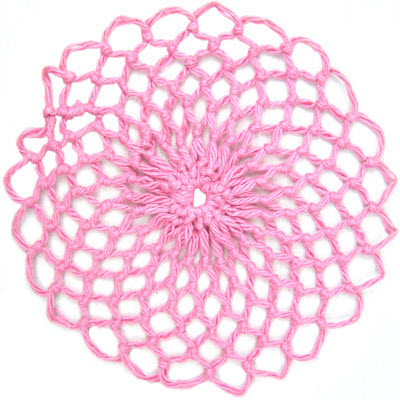
Fan Net Dishcloth


Even though I had to net this pattern more times than the other two patterns, I like the results. 

I wonder what would happen if I used a 3/8" gauge for the large mesh stick instead of the small mesh stick.  I wonder if it would fit on top of a net bookmark.  I wonder . . . 


Saturday, August 11, 2012

A New Net Toy and Netting Contest Results


My oldest son seems to enjoy finding and helping me design new and different netting projects.  He suggested that I net something other than doilies.  When I asked him what, he suggested netting snoods.  He was the one who helped me design the net Klein bottle bag.  So I was not too surprised when he recently suggested a new project.  He wanted me to net a poi.

"A what?" I asked, thinking that poi was something to eat.

It turns out that he was thinking of another kind of poi.  The kind of poi he meant is a ball on a chain, or a length of fabric that holds a ball.  Since he is into juggling and martial arts, I could see why he might want me to make one.

He was willing to help me design it, provided I make him a set in black and white. We came up with a single poi and a double poi.


I made the 2" balls out of black and white denim, using only two pieces and one seam.  The seam on the balls makes them look like baseball-shaped beanbags.  I used poly-fil by Fairfield to give them some weight and allow them to be washed.

*   *   *   *   *   *   *   *   *   *   *   *   *

The contest that ended last week had only two people brave enough to post their guesses.  They were both right, so I decided to make something for each of them.  Carmen has chosen to have me make her a set of mesh poi.  Lucy, let me know what you want.


Friday, August 3, 2012

An unusual-looking net bag


I have a friend who is battling cancer.  She has a PAC, a small machine that provides pain medication as she needs it.   That machine needs to stay with her.  The hospital provided her with a bag that was supposed to go over her head and one shoulder and hang down.  Because of various medical reasons no bag could hang across her neck and shoulder, so she asked me for help in designing a bag that would work for her.

We chose to make the bag of netting rather than fabric so she could access her machine without removing it from the bag.  The finished bag was certainly different from other net bags I have designed.


We attached the bag to a net belt that was pointed at each end.  The pointed ends make it easy to find the ends of the net belt.


The belt tied around her waist - the knot at one side.


Her machine was along her leg and within easy reach, so she could make any adjustments she needed to through the netting.


Now her machine rests beside her on her chair or the couch while she is sitting.  No more forgetting to grab it when she starts to walk.

It took only a bit of netting and part of an afternoon to help a friend.


UPDATE:  Some changes in the style of the bag.


Saturday, July 28, 2012

Gauge = mesh stick size and yarn size (continued)


Last week I showed three small round pieces of netting that changed size when the yarn and mesh stick size were increased.  This week I finished three more.

Here they are shown as the top of bookmarks.

Flower
Candle
Magic


And here they are shown as hot pads.


Hot Pad #1


Hot Pad #2


Hot Pad #3


Can you match the hot pad to the proper bookmark?  On August 4th, at noon EDT, the contest will end.  I'll put the names of all those whose comment included the correct answer in a bowl and draw out the winner.  The winner can choose either one net item from Knots Indeed (1,000 knots or less) and I'll make it for them, or 2 of my netting patterns.  Be sure to leave some way for me to contact you, in case you are the winner, otherwise I'll pick again.


Saturday, July 21, 2012

Gauge = mesh stick size and yarn size


I was looking at the patterns for my upcoming Circular Netting class.  I noticed that I had only one hot pad.  It uses the plain stitch.   


As I continued to transform the instructions for the net coasters from something I could understand to a handout everyone could understand, I realized I could have more hot pad patterns.  I just needed to make some changes to the coaster patterns.  

By using thicker thread and larger mesh sticks I went from coaster to hot pad.  The inserts in the acrylic coasters are just under 3 inches.  The hot pads are between 5 and 6 inches.


In knitting and crocheting how tightly you grip your yarn and needle affects the gauge and the finished size of your project.  This is not what happens with netting.  The finished size of an article of netting depends on the size of the yarn or thread and the size of the mesh sticks used.


Saturday, July 14, 2012

Net Handles for Bags


I first came across the idea for netting bags in Charles Holdgate's book Net Making.  For handles he suggested making several long strands and then tying a series of half-hitches in the center of those strands.  It worked, but not well.  I would arrive home after carrying groceries in the bags, with welts on my arms or cramped hands where the handle had rested.

No matter what I tried, thick cord, rope, or padded cloth, the handles dug into my skin.  I kept looking for an idea that would work.  Eventually someone graciously informed me that I could net the handle.  What an eye-opening concept!  Since then, most of my net bags have net handles.  The netting seems to spread the weight of the bag over a larger surface area and my hands, and arms no longer have problems carrying net bags.

This week, as I photographed the bags for my circular netting class,  I realized that I had taken a bag pattern and changed the look by changing just the handle.

One example is the medium-size circular bag.


The bag in each photo is the same size; the handle on the left is a draw-string, and on the right is a tied net handle.


I had a similar situation with the large size circular net bag.


The bag on the left holding five pounds of potatoes has a single net handle.


The bag on the right, holding a mixture of fresh vegetables, uses the same pattern for the bag and the start of the handle as the one on the left.  The center of this bag's handle is tied together rather than net together.

I like the tied handles for grocery shopping because I can tie the handles so the contents of the bag won't come out.


Saturday, July 7, 2012

Spiral Netting vs Circular Netting


While diamond-mesh and square-mesh netting are made with rows, spiral and circular netting are made using rounds

My grandmother taught me to net using spiral netting.  Spiral netting goes around and around until you change the size of the mesh stick or stitch pattern, or finish the project.  


Here is a doily she made for me to use as a pattern.  It is done in spiral netting and is a good example of some of the problems associated with spiral netting.


Here are some closeups of that doily highlighting three common problems experienced with spiral netting.  


The end of the netting is very obvious.  It just stops.


In the highlighted area there is a noticeable trail in the netting where the size of the mesh stick was changed.  It may appear as a jog in the round or a single long strand where there should be two or more strands forming a V. 


Counting the number of rounds becomes a challenge because the round has no definite beginning or end.

If you look closely in the highlighted area you can see that there are mostly 5 rounds of small white netting.  However, there are a couple of places where there are only 4 rounds.  This makes it difficult to know when to change to a new mesh stick or a new stitch.


It was years after I had learned to net that I found there was another way to net in a circle.   Thanks to a small public library I found Net Making by Charles Holdgate and learned about circular netting.


Here is the same doily made using circular netting.  


Circular netting joins each round with an overhand knot.  

This simple step eliminates the problems described with spiral netting.


This week I found myself adding more projects to the Circular Netting class I am creating.  There are now seven different types of projects in this class and 15 patterns:  3 bags, 3 bookmarks, 3 coasters, 3 dishcloths, a doily, a hot pad, and a snood.

If you could choose only one type of project to make while learning circular netting, which would it be?

You can look at the projects at Rita's Netting Nook.