Showing posts with label netting equipment. Show all posts

Thursday, August 8, 2024


Learn to Net through Videos

Netting is easier to learn with someone sitting near you, able to guide you through the learning process. However, because I can't physically sit next to you, I created videos to show you how to net. It's the next best thing to having a teacher by your side.

Since I have recently moved the netting videos from Rita’s Netting Nook to YouTube, the links to the videos are listed below.


Before Starting to Net - Equipment Used in Netting


Before Starting to Net - Filling Netting Needles and Shuttles


Before Starting to Net - Knots to Know Before Netting


Netting in Rows using the Lacemaker's Method


Troubleshooting the Lacemaker's Method


Basic Netting Supporting Skills


How to Net in Rows: Square-mesh Netting


Netting in the Round


Correcting Mistakes


Netting Techniques


Attaching Beads to Netting


Naming Stitches (2:08) - https://youtu.be/TdHMILa2dMw


Saturday, October 12, 2013

Encyclopedia of Needlework by Therese de Dillmont


Therese de Dillmont authored many books on needlework.  I recently learned that her Encyclopedia of Needlework, published in 1886,  is available in digitized format. Among the types of needlework, she includes a section on netting, which includes the following:

  1. Netting (page 395)
  2. Implements and Materials (page 395; illustrations 611-613)
  3. Stitches (page 397; illustrations 614-116)
  4. Patterns Produced in Netting (page 400; illustrations 617-633)
  5. Embroidered Netting (page 410; illustrations 634-691)

*          *          *          *          *          *          *          *          *          *          *          *          *          *

I've been promising to post the photos of the sun catchers I net during the last two weeks of September.  So here they are.  There are some 4", 5", and 6" ones.  If you want to see all the sun catchers I have designed, click here.
Chrysalis 
Flame
Ferris Wheel
Masaka
Jellyfish
Merry-Go-Round
Mum
Waves
Winter Festival
Glisten

Scallops
Music
Zinnia
Sand Dollar

Peony

Pompom

Moonlight

Poinsettia
Ferris Wheel, Poinsettia, and Zinnia are in 6" rings.  Glisten and Waves are in 4" rings.  All the others are in 5" rings.


Saturday, September 28, 2013

Netmaking by P. W. Blandford


In 1941 the first edition of Percy W. Blandford's book, Netmaking, was published.  It includes netting instructions for heavier cord.  There are many illustrations throughout the book.  According to the preface to the fourth edition, "the first edition of this book was written during uncomfortable evenings in an air-raid shelter in 1940."

The digitized version is located at http://pachamamatrust.org/.  Once you arrive at the website, click on the portion of the side menu labeled CORE and a new side menu will appear.  Click on Net & Rope (which is under Craft & Trade, which is under Employment).  The text and photos will appear on the right of the screen.

A special thanks to Anthony Emery for the link to this book.


*          *          *          *          *          *          *          *          *          *          *          *          *          *

The Eastern States Exposition (Big E) is held in September in West Springfield, Massachusetts.  This year I decided to go demonstrate netting.  During the 17 days it is open, I have been there netting for 7 days (about 4 hours each day).  It has been fun and exciting to introduce netting to those who stopped by while I was there.  Today was my last day, so I decided to take some photos of the lace demonstration area.


This case contains all the lace entries for this year, with the exception of the Best in Division.  There are examples of tatting, netting, and various types of bobbin lace.


The picket fence was decorated with net sun catchers I made during the last two weeks.  Some of them were made at the Big E while I was demonstrating, and others were made elsewhere.  I will try to post them on my website with the other sun catchers as soon as possible.

On the table are net bags, net scarves, a net shawl, and stitch samples, as well as two small pieces of tatting.   I included the tatting because people tend to ask me if I am tatting, and I wanted to show them the difference between the two.


This is also the first year I have submitted something to the Big E.  I submitted two doilies, Pineapple and Crystalline, and Lantern, a small net covered ornament ball.  The large white doily on the left of the lace case is one of the two doilies.  The red ornament ball is in the lower right corner.

With all the beautiful lace displayed in the lace case, I was surprised to learn that Crystalline had been selected as Best in Division for Lace.  It was displayed with the other Best in Division Winners.


I'm already wondering what I will enter next year.


Saturday, August 24, 2013

The Priscilla Netting Book

In 1914 The Priscilla Publishing Company added The Priscilla Netting Book to their list of craft publications.  It was edited by Belle Robinson.  There are several locations where this book may be found on-line;  The Hathi Trust Digital Library, The Open Library, On-Line Digital Archive of Documents on Weaving and Related Topics, and Internet Archive, to name four.  While much of the information is related to lacis or net embroidery, both on square-mesh as well as diamond-mesh, some patterns and stitches are not.  Most of the patterns and stitches include illustrations.

  1. Netting (page 3)
  2. Equipment - with illustration (page 3)
  3. To Work Netting - with illustration (page 4)
  4. Figures 6 and 9 - To make circular netting - with illustration (page 5)
  5. Figure 10 - To make a circular netting by increases - with illustration (page 6)
  6. Lace - with illustration on page 10, 37 - fig 85 (page 10, item 601)
  7. Centerpiece - with illustration (page 11, item 602)
  8. Doily - with illustration (page 11, item 603)
  9. Doily - with illustration (page 12, item 604)
  10. Netted Cape Collar - with illustration (page 14, item 608)
  11. Netted Round Yoke - with illustration (page 15, item 609)
  12. Centerpiece of Square and Circular Netting - with illustration (page 19, item 613)
  13. Centerpiece - with illustration (page 20, item 615)
  14. Netted Centerpiece - with illustration (page 25, item 620)
  15. Netted and Embroidered Doily - with illustration (page 26, item 621)
  16. Netted and Embroidered Doily - with illustration (page 26, item 622)
  17. Wide Netted Edging - with illustration (page 27)
  18. Netted Edging - with illustration (page 27)
  19. Doily - with illustration (page 28, item 623)
  20. Doily - with illustration (page 30, item 624)
  21. Doily - with illustration (page 30, item 625)
  22. Doily - with illustration (page 30, item 627)
  23. Netted Bow - with illustration (page 32, item 626)
  24. Centrepiece in Gros Filet - with illustrations (page 32, item 628)
  25. Doily - with illustration (page 33, item 629)
  26. Doily - with illustration (page 34, item 630)
  27. Netted Scallop - with illustration on page 32 (page 37, item 631)
  28. Insertion - figure 64 - with illustration on page 32 (page 48)
  29. Insertion - figure 65 - with illustration on page 32 (page 48)
  30. Insertion - figure 66 - with illustration on page 32 (page 48)
  31. Insertion - figure 67  - with illustration on page 32 (page 48)
  32. Edging - figure 68 - with illustration on page 33 (page 48)
  33. Netted Scallop - with illustration on page 33 (page 48, item 632)
*          *          *          *          *          *          *          *          *          *          *          *          *          *

Last week I mentioned that I had five more ornament ball covers to photograph.  By the time the week was over and I had finished the netting and photography, there were a few more than five.  My son made quick work of posting them online, and there are now 31 unique net ornament ball covers for you to look at.


Saturday, August 10, 2013

A Text-book of Needlework, Knitting and Cutting Out: with Methods of Teaching by Elizabeth Rosevear

A Text-book of Needlework, Knitting and Cutting Out: with Methods of Teaching by Elizabeth Rosevear was published in 1893.    She includes a brief history of netting, the tools used to make netting, how to tie the knot, and how to make square-mesh, diamond-mesh, round netting (what I call spiral netting), and the twisted stitch.  With only four pages devoted to netting, there is no room for patterns.

  1. Netting (page 439)
  2. Implements (page 440)
  3. Method (page 440)
  4. Square Netting (page 441)
  5. Oblong Netting for Window Curtains (page 442)
  6. Round Netting (page 442)
  7. Twisted Stitch in Netting (page 442)
*          *          *          *          *          *          *          *          *          *          *          *          *          *

Several months ago my oldest daughter asked me to make three handkerchiefs edged in netting, one each for herself and her two daughters.

It took me a while, but I finally found some gorgeous white handkerchief linen.  I traveled to a fabric-filled shop, Delectable Mountain Cloth, in Brattleboro, Vermont.  


I didn't realize I might want my camera, so I left it home.  However, I found a wonderful blog post about the shop that included many photos.


I cut out several of the handkerchiefs that very day, put them in a bag, and there they sat.

I knew I wanted to hemstitch the edges, but I was scared to try.


This week I took one of the scraps from that lovely linen and jumped in.


There were only three of us at the library knitting group this week.  I almost finished hemstitching the sample while there.

It's a good thing I started with a sample and that I have several more samples.  It's going to take some time to learn how to make the corners look neat.


Saturday, July 27, 2013

The Young Ladies' Journal Complete Guide (2nd edition) by E. Harrison


There are two sections on netting in The Young Ladies' Journal Complete Guide (2nd edition) by E. Harrison.  The first section is about how to net; the second section has netting stitches and patterns.  There is also a section on Guipure netting, also known as net embroidery, net darning, or lacis.  The illustrations of this book, which was published in 1885, are very clear and detailed.


  1. Implements Required - with illustration (page 19)
  2. To Fill a Netting-Needle - with illustration (page 19)
  3. Netting Mesh - with illustration (page 19)
  4. Stirrup (page 19)
  5. Knot for Joining - with illustration (page 20)
  6. Directions for Netting - with illustration (page 20)
  7. Square Netting - with illustration (page 20)
  8. Square Foundation of Two Sizes - with illustration (page 20)
  9. Oblong Netting - with illustration (page 20)
  10. Slanting Netting - with illustration (page 20)
  11. Wire Frame for Guipure Netting (page 20)
  12. Introduction (page 123)
  13. Common Netting  - with illustration (page 123)
  14. Mode of working a Netted Foundation with Holes for Embroidering Trefoils in - with illustration (page 123)
  15. Round Netting - with illustration (page 123)
  16. Loop Netting - with illustration (page 123)
  17. Diamond Pattern in Round Netting - with illustration (page 123)
  18. Square Pattern - with illustration (page 126)
  19. Cross-Netting - with illustration (page 126)
  20. Rose-Netting in Plain and Striped Varieties - with illustration (page 126)
  21. Star-Netting - with illustration (page 126)
  22. Stripe Netting - with illustration (page 126)
  23. Honeycomb-Netting - with illustration (page 126)
  24. Diagonal-Netting  - with illustration (page 126)
  25. Border: Plain, Honeycomb, and Rose Netting - with illustration (page 126)
  26. Insertion: Rose and Plain Netting edged with Crochet  - with illustration (page 126)
  27. Netting Foundation Interlaced with a Needle and Thread - with illustration (page 127)
  28. Trimmings - with illustration (page 127)
  29. Trimming: Netting - with illustration (page 127)
  30. Doily: Netting (with illlustrations) (page 127)
  31. Mode of Beginning a Circle - with illustration (page 127)
  32. Foundation with Needlework Pattern - with illustration (page 127)
  33. Open-Work and Darned Stripe - with illustration (page 127)
  34. Trimming, with Thick Loops and Fan Edge - with illustration (page 127)
  35. Loose Loop Pattern - with illustration (page 127)
  36. Lappet for Caps - with illustration (page 130)
  37. Scallop - with illustration (page 131)
  38. Border with Double Loose Loops - with illustration (page 131)
  39. Fan Netting - with illustration (page 131)
  40. Border with Bunches of Loops (page 131)
  41. Edging: Double Fan or Sheaf (page 131)
  42. Border with Round-Loop Heading (page 134)
  43. Diamond Pattern  - with illustration (page 134)
  44. Design with Twisted Loops  - with illustration (page 134)
  45. Stripe for Shawls - with illustration (page 134)
  46. Border: Rose and Sheaf Pattern - with illustration (page 134)
  47. Border with Tufts and Scalloped Edge - with illustration (page 134)
  48. Design: Long and Crossed Loops - with illustration (page 134)
  49. Border: Cross Netting and Twisted Loops - with illustration (page 135)
  50. Neckerchief - with illustration (page 135)
  51. Fringe - with illustration (page 135)
  52. Design for Antimacassars, Fichus, &c.: Darned Netting - with illustration (page 135)
  53. Tassel Fringe - with illustration (page 135)
  54. Netted Mitten - with illustration (page 135)
  55. Netted Night-net - with illustration (page 135)
  56. Netted Curtains - with illustration (page 136)


*          *          *          *          *          *          *          *          *          *          *          *          *          *

This week my son helped me add photos to my website.  They included net belts, bookmarks, dishcloths, and suncatchers.


Saturday, May 18, 2013

The Illustrated Girl's Own Treasury


Although no author is listed for The Illustrated Girl's Own Treasury, published in 1861, the title page indicated that it was created by editors of The Illustrated Boy's Own Treasury.  I was surprised that netting was only mentioned once in The Illustrated Boy's Own Treasury, and that was in reference to harvesting coral.  Nothing was said about how to make it.

The Illustrated Girl's Own Treasury does mention netting several times and describes how to make it, both  plain and fancy stitches.  There are also several illustrations included.


  1. Preparation for Netting (page 91)
  2. Plain Netting (with illustration) (page 91)
  3. Square Netting (with illustration) (page 91)
  4. Oblong Netting (with illustration) (page 92)
  5. To Make a Piece of Netting of Six, Eight, or Ten Sides, Working from the Centre (page 92)
  6. Round Netting (with illustration) (page 92)
  7. Honeycomb Netting  (with illustration) (page 93)
  8. Long Twisted Stitch  (with illustration) (page 93)
  9. Grecian Netting (with illustration) (page 93)
  10. Ground Net  (with illustration) (page 93)
  11. Spotted Netting (with illustration) (page 94)
  12. Diamond Netting  (with illustration) (page 94)
  13. Large Diamond Netting  (with illustration) (page 94)
  14. Spotted Diamond Netting (with illustration) (page 95)
  15. Leaf Netting  (with illustration) (page 95)
  16. Double Stitch (page 95)
  17. Long Stitch (page 95)
  18. To Work with Beads (page 95)
  19. Mesh (page 95)
  20. Embroidery on Netting (page 96)
  21. Implements (page 123)
  22. Contractions in Netting (page 128)
  23. Printer's Marks (page 129)
  24. Jewel-Box for Mama (page 136)
  25. Silk Net for the Hair (page 144)


*     *     *     *     *     *     *     *     *     *     *     

Back in 2007, I net a small bag using crochet thread.  The base of the bag was net first in the shape of a circle.  I wrote down everything except the amount of thread I used.  Recently I figured it would be a good idea to know how much thread I used, if I wanted to let others use my pattern, so I followed what I had written down and made the following bag.


When I showed my newly-completed bag at a local knitting group, one of the women exclaimed how perfect it would be to use when she went to an event where she did not want to carry a large handbag.  This bag would hold her wallet, keys, and maybe even a sandwich.  She could place it on her arm, and it would not slip off.


I liked her idea but explained that the size 10 crochet thread I had used may not be up to the stress which keys and a wallet might place on it.  Some of the threads had broken on my original bag, and that bag had just carried lightweight self-inking stamps.


I suggested making it with larger mesh and and string.  The string would be much sturdier and less likely to break.


I finished making this bag at the Connecticut Sheep, Wool, and Fiber Festival.  I thought that location was very appropriate since that is just the type of event my friend would use it at.


She thought it was just perfect, and now I know just how much thread or string each bag takes to make.


Saturday, April 27, 2013

The Lady's Manual of Fancy-work: A Complete Instructor in Every Variety of Ornamental Needle-work by Mrs. Matilda Marian Pullan


Mrs. Matilda Marian Pullan  was busy promoting needlework in the mid to late 1850s.  This week I'm listing the netting information found in her book, The Lady's Manual of Fancy-work: A Complete Instructor in Every Variety of Ornamental Needle-work.  This book was published in 1858.


  1. Plain Stitch - with illustration (page 84)
  2. Square Netting (page 85)
  3. Oblong Netting (page 85)
  4. Honeycomb Netting - with illustration (page 85)
  5. Round Netting - with illustration (page 86)
  6. Grecian Netting - with illustration (page 86)
  7. Long Twisted Stitch (page 86)
  8. French-Ground Netting - with illustration (page 87)
  9. Spotted Netting - with illustration (page 87)
  10. Diamond Netting - with illustration (page 88)
  11. Large Diamond Netting - with illustration (page 88)
  12. Spotted Diamond Netting - with illustration (page 89)
  13. Leaf Netting - with illustration (page 89)
  14. Double-stitch (page 90)
  15. Long-stitch (page 90)
  16. Netting With Beads (page 90)
  17. Darned Netting (page 90)
  18. Flanders Lace - with illustration (page 90)
  19. Embroidery on Netting (page 91)
  20. Vandyke Square Netting (page 91)
  21. Another Pointed Edge (page 92)
  22. Shell Edge (page 92)
  23. Another Shell - with illustration (page 92)
  24. Another Lace (page 93)
  25. Another Edging (page 93)
  26. Netting Needles (page 182)


*     *     *     *     *     *     *     *     *     *     *     *     *     *     *     *


I'm nearly done making and photographing all the doilies I have photocopies of that my grandmother designed.  This is the next to the last one.  I would have finished the last one, but I ran out of thread and had to order more so it would match. Fortunately it was a "no dye lot" type of crochet thread.  It arrived today, so maybe by next week I can have the last one completed.

I named this doily Gyre.  The heart stitches in the middle made me think of circular motion, and that is what gyre means.  The Block Edge was a favorite of Grandmother's.


I spent most of today at the Connecticut Sheep, Wool, and Fiber Festival held in Vernon, Connecticut.  A good friend, who belongs to the Society of Creative Anachronisms (SCA), invited me to join with her group as they demonstrated some of the fiber arts that were done during the Middle Ages.  She offered me a ride and furnished some garb (so I would not look out of place with the rest of the group).   How could I refuse to demonstrate netting?

I met many wonderful people who had no idea what I was doing when they first saw me.  There was also a handful of people who recognized what I was doing.  It was a great experience.  I'll have to do it again.

Saturday, April 20, 2013

The Lady's Dictionary of Needlework by Matilda Marian Pullan


As I looked at Matilda Marian Pullan's book, The Lady's Dictionary of Needlework , published in 1856, I noticed that the patterns are for stitches and not for objects.  She describes how to get ready to net and how to tie the netting knot.  She has an illustration at the beginning of many of the stitches. 
  1. Preparation for Netting (page 18)
  2. Plain Netting - with illustration (page 18)
  3. Square Netting - with illustration (page 19)
  4. Oblong - with illustration Netting (page 19)
  5. To Make a Piece of Netting of Six, Eight, or Ten Sides, Working from the Centre (page 20)
  6. Round Netting - with illustration(page 20)
  7. Honeycomb - with illustration Netting (page 20)
  8. Long Twisted Stitch - with illustration (page 21)
  9. Grecian Netting - with illustration (page 21)
  10. Ground Net - with illustration (page 21)
  11. Spotted Netting - with illustration (page 22)
  12. Diamond Netting - with illustration (page 22)
  13. Large Diamond Netting - with illustration (page 22)
  14. Spotted Diamond Netting - with illustration (page 23)
  15. Leaf Netting - with illustration (page 23)
  16. Double Stitch (page 23)
  17. Long Stitch (page 23)
  18. To Work with Beads (page 24)
  19. mesh - definition (page 24)
  20. Embroidering on Netting (page 24)
  21. Implements For Netting (page 57)
  22. Printer's Marks (page 63)
  23. Contractions in Netting (page 63)
*     *     *     *     *     *     *     *     *     *     *     *     *     *     *

I want to have a photograph showing the entire doily for each doily I have a photocopy of.  This doily, Star In The Center, is one of the last of those that my grandmother designed that did not have a digital photograph.  Here is the photocopy.


 Here is a photograph of the full doily I just finished.


It's hard to see the individual stitches on the photograph.  I think both the photocopy and the photograph have a use.

Saturday, February 9, 2013

The Ladies' Hand-book of Knitting, Netting, and Crochet by the author of "The Ladies' Hand-book of Fancy Needlework and Embroidery"


There are at least two digital copies of  The Ladies' Hand-book of Knitting, Netting, and Crochet  by the  author of The Ladies' Hand-book of Fancy Needlework and Embroidery.  This link is to the one that seems to have all its pages scanned.  The other copy is missing many of the even numbered pages.  As far as I could tell, the earlier book by this author, The Ladies' Hand-book of Fancy Needlework and Embroidery,  does not appear to have been digitized yet.  A few libraries and museums have copies.

The following list of netting history, equipment descriptions, stitches and patterns are included in The Ladies' Hand-book of Knitting, Netting, and Crochet:


  1. history of netting (page vii)
  2. Necessary Implements for Netting (page 7)
  3. Plain Netting (page 13)
  4. Net with Points (page 16)
  5. Net with Beads (page 16)
  6. Grecian Netting (page 17)
  7. Diamond Netting (page 17)
  8. Plain Open Netting (page 19)
  9. Plain Netted Mittens (page 39)
  10. Netted Cuff, with Silk and Wool (page 40)
  11. Netted Fringe (page 41)
  12. Plain Netted Gentleman's Purse (page 41)
  13. A Lady's Purse (page 41)
  14. A Purse with China Silk (page 42)
  15. A Seam Purse, with Beads (page 42)
  16. A Netted Bag, with Ring (page 42)
  17. Dice Pattern Purse (page 42)
*   *   *   *   *   *   *   *   *   *   *   *   *   *   *   *   *   *   *   *   *   *   *   *   *   *   *

Mother Nature has a way of putting a hold on activities otherwise planned.  The beginning netting classes I was planning to teach today at  Novice Schola were cancelled because of the feet of snow dumped on us last night.  


This is what I saw when I opened the door to the carport.

The front door would not open because of the snow piled against it on the outside.

We measured about 21" depth of snow in the driveway. (photo on the right)


Last week, while we still thought the event would happen, I was trying to come up with a quick, easy project to make in square-mesh netting.  My SCA (Society for Creative Anachronism) friends made a suggestion.


When I showed it to them, they agreed it was just what they had envisioned -- a Cup Cover


What is that?  Think back to the last picnic you had.  You had a cup of something to drink that the flies wanted to sample.  This net cup cover, placed over your cup, will keep the flies, bees and other flying creatures out of your drink.  At least that's what my friends assured me.  Today, there are no flies outside to experiment with, and I'm not going to take a cup of anything outside in this weather.  I'll sip my hot chocolate by the heater.

The netting is 6" square and made with string and a 3/8" mesh stick.  The glass beads at the corners add weight to the cover so it won't blow off.


Saturday, February 2, 2013

The Handbook of Needlework by Miss Lambert


Published in 1842, Miss Lambert's book The Handbook of Needlework can be found online in two different places.  Click here to see it at one location and here to find it at the other location.  She includes information on the tools used in netting, some information on the history of netting, a description of how to tie the netting knot, some stitches (with illustrations of the finished stitch), and some patterns.  Four of the instructions are in French, and, since I don't read French, I can't say what she is describing in those four portions.


  1. Implements: Netting Needles and Meshes (page 92)
  2. Antiquity of the Art (page 224)
  3. Plain Netted Gentleman's Purse (page 228)
  4. A Lady's Purse (page 229)
  5. Gentleman's Purse with Ends of Different Colours (page 229)
  6. A Lady's Purse with Points (page 229)
  7. A Pretty Purse with Chinè Silk (page 230)
  8. Netting with Beads (page 230)
  9. A Plain Netted Purse with a Bead Mouth (page 230)
  10. A Pretty Sème Purse with Steel or Gold Beads (page 231)
  11. An Elegant Netted Purse with Steel Beads (page 231)
  12. Plain Netted Mittens (page 232)
  13. A Knitter's Bag with Ring (page 232)
  14. A Checked or Dice Pattern Purse (page 233)
  15. Grecian Netting or Filet Rose (page 233)
  16. A Purse in Grecian Netting (page 234)
  17. Mittens in Grecian Netting (page 234)
  18. Netted Fringe (page 235)
  19. Single Diamond Netting (page 235)
  20. Treble Diamond Netting (page 236)
  21. Diamond Netting, with Five Stitches (page 236)
  22. Sème Purse, Diamond Pattern (page 238)
  23. Open Plain Netting, or Filet a Bagaette (page 239)
  24. Fond de Berlin (page 239, written in French only)
  25. Filet Rose (page 240, written in French only)
  26. Filet a Baton Rompu (page 240, written in French only)
  27. Filet Rond (page 241, written in French only)
  28. Netted Mittens with Silk and Wool (page 241)
  29. Netted Cuff with Silk and Wool (page 242)


I have been asked to teach a beginning netting class for Novice Schola this coming Saturday.  I have been trying to come up with a pattern that teaches the basic skills, uses the sizes of the inexpensive mesh sticks I got, can be finished within 2-3 hours, and is something that might have been used several centuries ago.  I decided on a net bag.

In trying to create a pattern that would fit my needs I felt a bit like Goldilocks.


The first bag had way too many knots - 618.


The second bag was better, but still had too many knots - 558.


Finally, the third bag looked just right - 360 knots.

I can finish it in under an hour.  I hope the students can get close to being done within two to three.


Saturday, November 24, 2012

Knitter's Friend by Mrs. Hope


I discovered that I have links to two books named The Knitter's Friend.  One is by Mrs. Gaugain and the other is by Mrs. Hope.  They both contain netting patterns.  I wrote about The Knitter's Friend by Mrs. Gaugain almost a month ago.  Today I picked up The Knitter's Friend by Mrs. Hope.  It was published about 1847.

There are instructions for 10 different items related to netting.
  1. Stirrup for Netting   (page 44) - This is what I would call a tension device.
  2. Plain Netted Purse   (page 78)
  3. Rounded Neckerchief   (page 82)
  4. Invalid's Supporter   (page 84)
  5. Double Netted Shawl   (page 85)
  6. Circassian Cap   (page 86 - picture included)
  7. Front of an Upright Piano, or A Window Blind   (page 88)
  8. Cardinal Cape (page 90)
  9. Bottle Stand   (page 93)
  10. Round Netted Doyley   (page 94)

I recently made two long snoods with staggered beads.  One was with 6 mm glass beads and brown thread.


The other was made with 6 mm beads that were much lighter than glass.  The red beads were netted with black thread.


If the hair color matches the thread color of the snood, the netting vanishes into the hair and only the beads are left to be seen.  


I finally finished all the projects for my Circular Netting class, photographed them, and put them up on Rita's Netting Nook.  I purposely created many smaller projects so those taking the class would be able to practice starting net circles without getting bored.  


Saturday, January 14, 2012

Netting Needles or A Wonderful Husband


Christmas brought a fun and exciting present for me -- a brass netting needle.  Part of the reason it was fun and exciting is that it was unexpected.  I did not expect my husband to get it from Pallia, but he did.


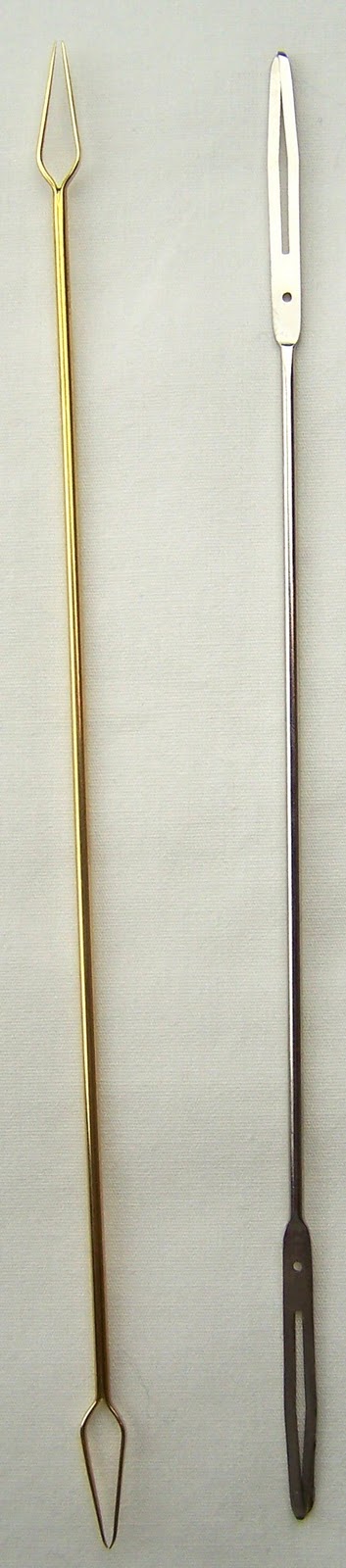
Another reason it was exciting and fun is that this netting needle is a different shape than others I have used to make lace items.


When my grandmother taught me to net, she used one similar to the needle on the right.  That was the only kind of netting needle we could get.  She taught me to fill the right side of the needle and then the left side.

With my new needle I could see the advantages of filling the needle using a figure-eight pattern.

I was impressed with the amount of thread my new needle held and yet it still fit through the loops.


Finally it was fun because it gave me an excuse to finish a doily I was designing and a new beaded snood.  I named the 22.5 inch doily Bachelor Button since it reminded me of the flower.


The snood was made using two strands of sewing thread.  My new needle had no problem getting into the spaces I wanted it to.


The beads in this snood are attached to the side of the diamond shaped mesh.


Saturday, October 8, 2011

Netting around the Net


About a year ago I found a marvelous netting needle.  I mentioned it in a post.  Then one day I went to look at it again and it was gone.  Today I learned that the shop is back up, including the English version.  It was great to see the netting needle again.  Now I get to start saving my pennies again.

Today I also found that Barry Brown has updated his blog.  While browsing in his net making section I found a wonderful looking hammock.  Now, to get him to share his pattern.

I've been working on the videos for Netting, More or Less.  I'm got two left to finish and they are both partially done. I would love to finish them up on Monday and Tuesday, but I've promised my son to work on a Mistborn cloak for Halloween on Monday.  He doesn't think I can get it done in a day.  We'll see.


Saturday, August 27, 2011

New Netting Tools

Recently I acquired some new netting toys tools from Marie-Jo at FILET LACE BY THE SEA.  I have enjoyed looking at them and playing with using them.


They feel so smooth I could just keep rubbing them all day.  I have not yet tried the two smaller ones, but I have used the largest.  It's narrower than my white plastic one, but since it is thicker, it produces the same size meshes.

Along with the mesh sticks came the needle on the left.

I got the needle on the right after Marie-Jo showed me some photos of a few handmade netting needles she had.  I am so glad I ordered one.  It is so much sturdier than the other needles I have seen (like the one next to it in the photo).  So, if you are looking for small netting needles for fine netting, contact her.